Neurofeedback side effects are real but temporary. Learn what causes them, when to worry, and how supervised clinical care minimizes risk.
You typed "neurofeedback ruined my life" into a search bar, or maybe "can neurofeedback damage your brain." Either way, something about your experience or your fear brought you here, and you deserve a straight answer rather than vague reassurances. Neurofeedback side effects are real, they are documented in peer-reviewed research, and they are also, in the vast majority of cases, temporary and explainable.
Neurofeedback is a brain-training technology that measures your electrical brain activity and uses real-time audio or visual feedback to help your nervous system learn new patterns. Like any form of meaningful neurological training, it can produce reactions as your brain adjusts. Fatigue, mild headaches, and heightened emotions after sessions are not random. They have a biological explanation rooted in how the brain responds to learning.
This post walks you through exactly what is happening during and after a session, why certain responses occur, what the clinical research actually says about safety, and, critically, which specific signals should prompt a conversation with your clinician. Knowledge replaces fear, and that is precisely what you will find here.
What Neurofeedback Actually Does to Your Brain
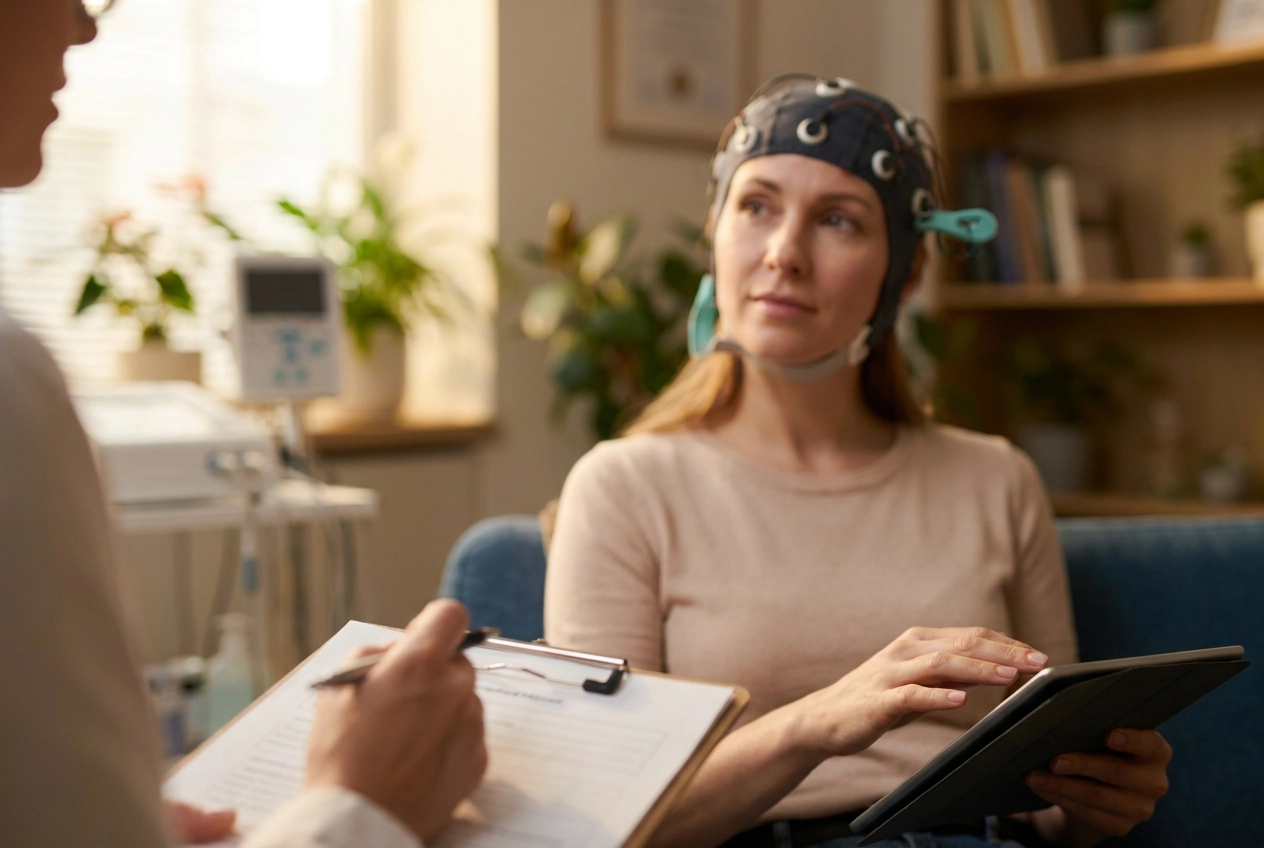
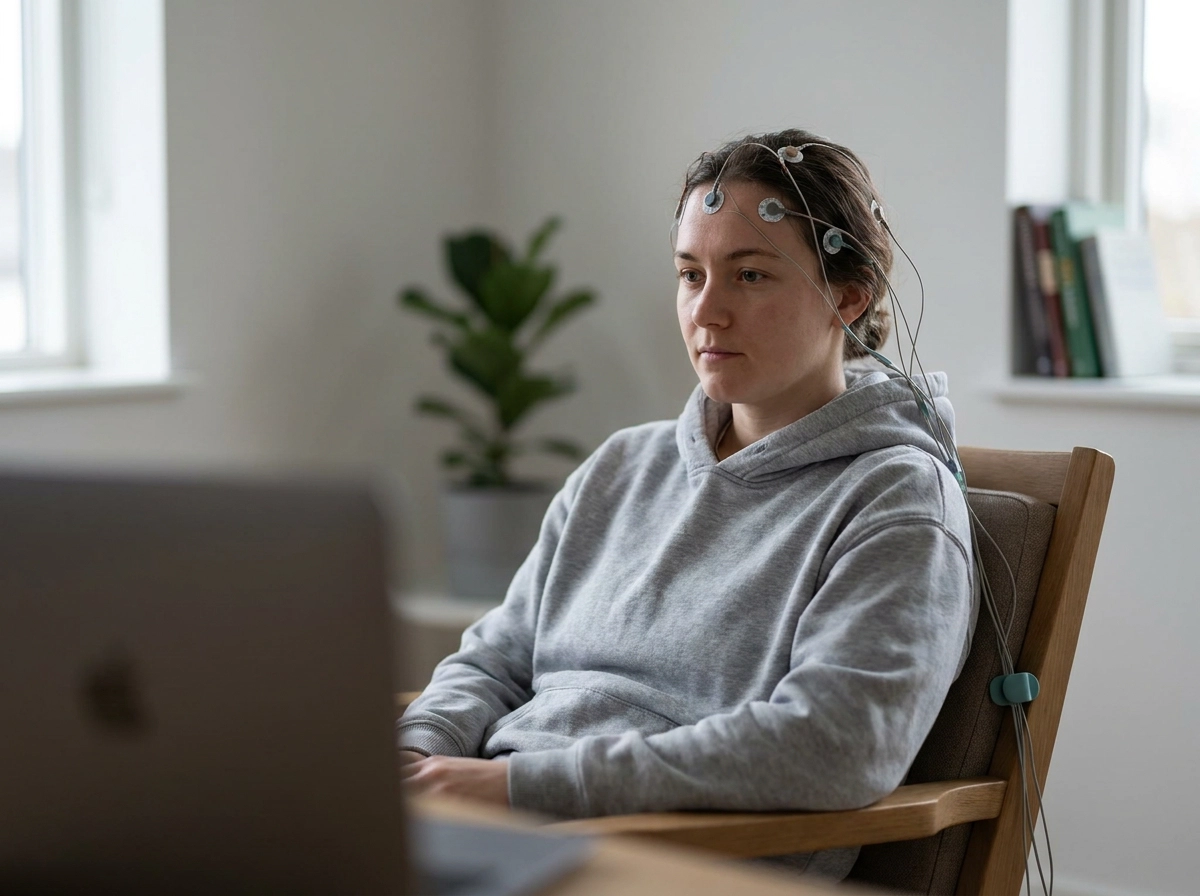
Neurofeedback is an EEG-based biofeedback modality that teaches your brain to self-regulate. During a session, sensors placed on your scalp read your brain's electrical activity in real time. When your brainwaves move toward a clinician-selected target pattern, you receive immediate audio or visual feedback, a tone, a brightening image, a reward signal. No electrical current enters your brain. No medication is involved. The sensors only listen; the feedback is the entire mechanism. For a fuller overview of how the process works in practice, see what is neurofeedback?
The reason this works is neuroplasticity, the brain's ability to physically reorganize its activity patterns in response to repeated experience. This is the same process that lets you learn a new language, master a musical instrument, or recover movement after a stroke. Each neurofeedback session is, essentially, a structured repetition that nudges neural firing patterns in a targeted direction. Over time, the brain consolidates those patterns.
That reorganization is also the reason side effects happen at all. Neuroplasticity is not passive; it demands metabolic effort and produces a period of adjustment as new patterns compete with old ones. That adjustment window can generate temporary neurological signals, fatigue, mild headache, emotional sensitivity, before the new state stabilizes. These signals are evidence that training is working, not that something is going wrong.
The specific discomfort a patient experiences depends directly on which protocol the clinician selects. Neurofeedback targets distinct brainwave frequency bands, each governing different functions:
Delta: deep sleep and recovery
Theta: drowsiness, memory consolidation, emotional processing
Alpha: relaxed wakefulness, stress regulation
Beta: focused attention and cognitive performance
Gamma: higher-order processing and sensory binding
Electrode placement compounds this variability. A beta-uptraining protocol over the frontal lobe produces a different post-session response than alpha/theta training over the parietal region. Protocol choice is not incidental; it directly shapes what you feel afterward.
This matters especially for the populations most likely to pursue neurofeedback. Concussion, TBI, PTSD, anxiety, depression, and ADHD are among the conditions commonly associated with dysregulated brainwave patterns at baseline. A brain already operating outside its normal range enters training with less tolerance for additional perturbation. Post-session responses in these groups tend to be more noticeable, and sometimes more prolonged, than in neurologically typical individuals. That context is essential when you are trying to interpret what you feel after a session.
The Most Common Neurofeedback Side Effects (and Why They Are Temporary)
That neuroplasticity workload described in the previous section has a direct, predictable consequence: the brain produces signals during its adjustment phase that can feel unsettling if you do not know what to expect. The five responses below account for the overwhelming majority of what patients report after sessions. Each one has a specific neurological explanation, and each one carries the same defining characteristic: it fades.
Mental fatigue is the most widely reported post-session response. Mental fatigue after a session reflects the effort your brain exerts during training. This typically clears as the brain settles after training.
Tension headache or pressure behind the eyes can follow a session for several reasons working independently or together: sustained concentration, mild scalp pressure from sensor placement, and early neurological adjustment during the training process. This type of headache is dull and diffuse rather than sudden or localized, which is what distinguishes it from a headache that warrants medical attention.
Heightened emotional sensitivity or irritability surfaces most often when protocols target frontal or limbic regions. Training those areas requires recalibration of emotional processing circuits. This is neurological recalibration. It is not evidence that neurofeedback is destabilizing you psychologically.
Vivid dreams or mildly disrupted sleep in the first several sessions is particularly common with theta and alpha/theta protocols. Those frequency bands are closely involved in sleep-related neural activity. Some patients notice changes in sleep quality before their cycles stabilize, which typically happens within the opening weeks of a training program.
Transient "fuzzy" thinking or difficulty concentrating appears most often in early sessions, when the brain's executive networks are actively reorganizing their firing patterns. Counterintuitively, this is a sign that training is engaging the right systems. It diminishes as the protocol progresses, and research tracking adverse events in neurofeedback clinical trials documents this kind of early-session cognitive response as a recognized, monitored phenomenon rather than an unexpected finding.
The clinical thread connecting all five responses is the same: they are time-limited, linked to the session rather than continuous, and become less pronounced as training accumulates. That trajectory is the opposite of a genuine adverse neurological event, which would escalate or persist independent of sessions. If what you are experiencing follows the pattern above, your brain is adapting. If it does not follow that pattern, the next sections explain exactly when to contact your clinician.
Can Neurofeedback Damage Your Brain? Addressing the Fear Directly
Those temporary, session-linked responses described above share one important characteristic: they are signs of a brain adapting, not a brain being harmed. The harder question many patients bring to their first search is whether neurofeedback can cause something more permanent.
The direct answer is no, and the mechanism explains why. Sensors sit on the scalp and read electrical activity; the feedback your brain receives is purely sensory, a sound or a visual change on a screen. Your brain is responding to information, the same way it responds to any stimulus. To learn more about what is actually happening at the neurological level, how neurofeedback helps heal the brain provides a useful foundation.
The peer-reviewed evidence reflects this. A 2023 systematic review and meta-analysis across 17 randomized controlled trials found a pooled adverse effect prevalence of just 0.05, with no reports of structural brain damage across included studies. Separate systematic reviews evaluating neurofeedback in medically fragile populations, including cancer patients with significant cognitive concerns, have also produced no documentation of structural harm.
Feeling worse is not the same as being harmed. That temporary intensification reflects the brain reorganizing its activity patterns, not sustaining damage. The distinction is clinically significant.
Compared to SSRIs, stimulants, or benzodiazepines used for the same conditions, supervised neurofeedback carries no systemic side effect profile, no dependency risk, and no documented pathway to structural brain change.
The word "supervised" carries weight here. Improperly selected protocols, self-administered training, and consumer-grade headsets without clinical oversight represent a meaningfully different intervention than supervised clinical neurofeedback. The risk profile changes substantially when qualified clinician judgment is removed from the process.
"Neurofeedback Ruined My Life": Understanding What Is Behind These Experiences

Some patients have experienced genuine, prolonged worsening after neurofeedback, and those reports deserve a direct answer rather than dismissal. A peer-reviewed randomized controlled trial confirms that transient adverse side effects during neurofeedback training are real and warrant formal clinical investigation, not minimization. The honest answer is that most documented bad outcomes trace to preventable process failures, not the technology itself.
The four most common root causes of poor outcomes are:
Protocol-patient mismatch: Uptraining beta frequencies in a patient who is already neurologically hyperaroused, such as someone with active anxiety, can intensify symptoms rather than calm them. The brain is being pushed further in a direction it does not need to go.
Incorrect electrode placement: Sensors positioned over the wrong cortical region generate feedback that trains against the patient's actual neurological needs.
Insufficient intake screening: Skipping a thorough medical and neurological history means known risk factors go undetected before training begins.
Ignoring early warning signs: Patients who noticed early worsening but were not asked to report it, or whose reports were not acted on, continued receiving a protocol that was clearly not working.
Quantitative EEG brain mapping directly addresses this failure mode by grounding protocol selection in the patient's individual neurological data rather than a generic template. For patients also managing anxiety-driven panic responses, understanding this individualized approach is explored further in how qEEG brain mapping and neurofeedback are reshaping drug-free panic attack treatment.
When persistent worsening is reported, a qualified clinician pauses training, reviews electrode placement and protocol parameters, and reassesses. That response is standard clinical practice. It is not evidence that neurofeedback caused irreversible harm; it is evidence that the protocol needed refinement.
Patients searching this phrase most often received care in settings without adequate screening, credentialed oversight, or structured adverse event monitoring. The clinical environment and practitioner qualification are not secondary considerations; they are core safety variables.
Can Neurofeedback Make You Worse? Temporary Setbacks vs. Genuine Concerns
The question deserves a direct answer: yes, neurofeedback can make you feel worse, but whether that worsening is a problem depends entirely on its pattern.
Transient amplification vs. a clinically significant signal
Early-session symptom amplification is a recognized neuroplasticity response. Your brain is being trained to reorganize firing patterns, and that process can temporarily surface the symptoms you came in to resolve. What separates this from a genuine concern is trajectory. Transient worsening diminishes over successive sessions. Persistent or escalating symptoms that do not follow that diminishing pattern are a clinically significant signal requiring a protocol review.
The typical adjustment arc
Most patients encounter one or two sessions where fatigue, emotional sensitivity, or brain fog feels more pronounced than usual. This is followed by a gradual stabilization, then measurable improvement. That arc is not linear; there are fluctuations. Recognizing the arc prevents premature dropout, which is one of the most common reasons patients fail to see the outcomes neurofeedback can produce. Understanding that a harder session is not a sign of harm, but a stage in adaptation, matters.
Signs that warrant a protocol review
Contact your clinician, rather than stopping treatment, if you notice any of these:
Symptoms that worsen with every session rather than stabilizing
New symptoms that were not present at your initial intake
Sleep changes that persist across sessions without any sign of resolving
Emotional dysregulation that is interfering with daily functioning between sessions
These signals call for protocol adjustment, not abandonment.
Why TBI and concussion patients may feel it more
A brain recovering from injury carries lower homeostatic reserve. It has less neurological buffer for the demands of early training, so the adjustment phase can be more pronounced. This is not a contraindication to neurofeedback; it is a reason for careful pacing and closer monitoring. The challenges and limitations of neurofeedback in trauma recovery are well-documented, and experienced clinicians account for them in protocol design from the outset.
The honest bottom line
In a supervised clinical setting, the appropriate response to early worsening is protocol adjustment, not continued exposure to a protocol that does not fit.

Why Is Neurofeedback Controversial? A Balanced Look at the Evidence
The controversy around neurofeedback is real, but it is narrower than search results suggest. The core objection from academic critics is methodological, not safety-based: published trials have been faulted for small sample sizes, inconsistent protocols across research teams, and substantial heterogeneity that makes pooling results difficult. Researchers examining neurofeedback across populations have explicitly called for larger samples and greater variability before conclusions could be generalized, and that language reflects a genuine limitation of the current evidence base.
The sharpest methodological challenge is the sham-control problem. Drug trials can give one group a sugar pill that looks identical to the real treatment. Neurofeedback cannot replicate that design cleanly. Because EEG feedback is perceptible, patients can often sense whether they are receiving real training, which compromises blinding and lowers a study's quality score under conventional pharmaceutical research standards. This does not mean the intervention fails; it means the intervention is structurally difficult to study the same way a pill is studied.
That same structural problem applies to EMDR, cognitive behavioral therapy, and virtually every other non-pharmacological treatment in clinical use. A therapist cannot be blinded to whether they are delivering CBT. The methodological bar developed for drug trials was not designed with experiential interventions in mind, and applying it uniformly produces an unfair comparison. Controversy about research design is not evidence of ineffectiveness.
Clinical adoption tells a parallel story. Systematic reviews now examine neurofeedback across populations well beyond ADHD, including cancer patients managing treatment-related fatigue, TBI survivors, and people with PTSD, with a 2025 meta-analysis in Frontiers in Neuroscience representing active expansion into trauma research. A doctoral meta-analysis spanning 21 studies reported effect sizes across diagnostic categories including tinnitus, schizophrenia, insomnia, and pain. Practitioners treating these populations are not operating on anecdote; they are responding to accumulating clinical outcome data.
The distinction that matters most is this: "requires more research" and "does not work" are not the same statement. Peer-reviewed literature, including a comprehensive review of neurofeedback system design and clinical applications, consistently frames neurofeedback as a promising and generally safe modality with an evidence base that is still maturing. For a fuller examination of where the research stands and where it has honest gaps, Addressing the Skeptics: What the Evidence Actually Shows (and Where It Has Limits) goes deeper on that question. Promising and evolving is a categorically different position than discredited, and the scientific literature does not support the latter.
Is Neurofeedback Therapy Legit? What Makes a Clinically Sound Program
Controversy about research design is not the same as a verdict on clinical value. The more useful question for anyone considering neurofeedback is simpler: is this a legitimate, evidence-informed intervention, and how do you know whether the program in front of you meets that standard?
On legitimacy, the answer is straightforward. Neurofeedback is not fringe medicine. It is the subject of peer-reviewed research indexed by the NIH, including systematic reviews evaluating its safety and clinical applications across ADHD, PTSD, anxiety, depression, TBI, and concussion. Active research continues into 2025 and 2026, placing neurofeedback firmly within mainstream clinical neuroscience inquiry, not outside it.
What Separates a Clinical Program from a Consumer Product
The legitimacy of neurofeedback as a modality does not automatically extend to every product or provider offering it. The meaningful distinction lies in how it is delivered.
A clinically sound program includes:
Licensed clinician oversight at every stage of care
Pre-treatment intake screening to identify contraindications and establish a symptom baseline
Individualized protocol selection based on the patient's specific neurological profile
Session-by-session symptom monitoring to detect adverse responses early
The authority to adjust or pause treatment when the patient's response warrants it
Consumer headsets and app-based neurofeedback share a name with clinical neurofeedback but not the same risk controls. Removing clinician oversight removes the primary safety mechanism.
What qEEG Brain Mapping Adds
A quantitative EEG assessment transforms protocol selection from a generic template into a data-driven plan, directly addressing the most common thread in reported adverse experiences. If you want a plain-language walkthrough of how this process works from brain map to final session, this guide to neurofeedback and brain mapping covers it clearly.
At Neuron Connect, the clinical framework follows this sequence: intake screening, qEEG assessment, individualized protocol design, ongoing session monitoring, and clinician-led adjustments guided by each patient's goals, whether that is cognitive recovery, emotional regulation, or performance optimization.
The Questions Worth Asking Any Provider
Your due diligence matters. Before starting with any neurofeedback provider, ask directly: How is my protocol selected? What is your clinician's training? How do you manage adverse responses if they occur? A qualified provider will answer those questions without hesitation. Reluctance to answer is itself clinical information.
The Safety Protocols That Make Supervised Neurofeedback Low-Risk
Knowing what a legitimate program looks like is useful; understanding the specific mechanisms that keep it safe is what lets you walk into a session without anxiety about the process itself.
Pre-treatment screening is the first line of defense. Before any training begins, a thorough intake evaluation establishes your symptom baseline and surfaces neurological history that changes how treatment should proceed. A prior seizure disorder, active psychosis, or a head injury still in the acute recovery phase are not automatic disqualifications, but they do require modified protocols or temporary deferral. Screening catches these factors before they become problems mid-treatment. For a deeper look at candidacy criteria, Is Neurofeedback Safe? Who Is a Good Candidate and Who Should Discuss It First covers the full picture.
qEEG-guided protocol selection removes guesswork from the equation. Objective brainwave mapping before the first session gives the clinician a data-based picture of your specific dysregulation pattern. Training frequency and electrode placement are then matched to that individual profile. A one-size-fits-all approach skips this step and measurably increases the risk of an adverse response because the protocol may be mismatched to your neurological baseline.
Session-by-session symptom tracking turns each appointment into a safety checkpoint. Structured check-ins before and after every session allow the clinician to spot emerging adverse patterns early, when a minor adjustment to the protocol resolves the issue rather than allowing it to accumulate into a reason to stop treatment entirely.
Trained clinician oversight is the central safety mechanism, not a secondary one. The clinician's judgment, informed by your ongoing symptom data, is what keeps the protocol appropriate as your brain changes across sessions.
Escalation pathways should be explained to you before treatment begins, not after a difficult session. A well-run clinic operates with clear internal criteria for when to modify a protocol, when to pause training entirely, and when to refer for additional neurological or psychiatric evaluation. Asking your provider to walk you through this process at intake is a reasonable and clinically sensible question.
When to Tell Your Clinician: The Specific Signals That Warrant a Call
Those safety protocols only function when your clinician has accurate, timely information. Here is how to give them that.
Call your clinician after any session if you experience any of the following:
A headache that persists well beyond the session and does not resolve with rest
Emotional distress that feels qualitatively different from ordinary post-session sensitivity
New neurological symptoms: visual disturbances, coordination difficulty, or changes in speech
These are not expected training responses. They require prompt protocol review, not a wait-and-see approach.
Contact your clinician between sessions if:
Sleep disruption that persists across multiple sessions without improvement
Mood changes are affecting your relationships or work performance
Baseline anxiety or depression has increased and shows no sign of reversing as training continues
Do not wait for your next scheduled appointment to report dissociative episodes, panic attacks that are new or significantly more frequent than before treatment, or any symptom that feels like a return to the worst phase of your condition. These signals require immediate clinical attention, not a spot on next week's agenda.
Reporting is not a complaint. It is clinical data. Your clinician cannot adjust electrode placement, training frequency, or session intensity based on information they do not have. A side effect reported promptly is a protocol refinement opportunity; the same symptom left unreported becomes a reason patients unnecessarily abandon treatment that could have been corrected.
Keep a brief daily symptom log between sessions. Each day, note your sleep quality, a simple mood rating, energy level, and any notable symptoms. A single data point tells your clinician very little; a week of entries reveals the pattern that distinguishes a normal adjustment phase from a meaningful adverse trend. A notes app on your phone works. So does a paper notepad. The format matters far less than the consistency.
What Side Effects Are Actually Telling You About Your Treatment
Once you have a clear system for reporting symptoms, the larger picture comes into focus: what your side effects are actually communicating matters more than the discomfort itself.
Mild fatigue, a temporary headache, or a day of heightened emotional sensitivity after a session are not warning signs. They are evidence of neurological adaptation, a brain actively reorganizing its activity patterns in response to training. Discomfort during adaptation is not the same as damage.
That distinction divides the people reading this into two groups, and each group needs a different response.
If your symptoms are mild, session-linked, and gradually easing over successive training sessions, the appropriate response is to continue. You are in the adjustment phase that supervised neurofeedback anticipates. If your symptoms are persistent, escalating, or qualitatively different from normal post-session fatigue, the appropriate response is to contact your clinician for a protocol review, not to stop treatment entirely. Protocol adjustment is a routine clinical tool, not an admission that something went wrong.
Two practical steps to carry forward:
Ask about qEEG-based protocol selection if that conversation has not happened yet
Recognize that supervised clinical neurofeedback and unsupervised consumer use are structurally different interventions with different risk profiles
If side effects have made you hesitant to start or continue treatment, Neuron Connect's clinical team in Arizona offers qEEG brain mapping assessments before any training begins. Knowing your individual brainwave profile allows clinicians to build a protocol around your neurology specifically, which is the most direct path to minimizing unnecessary discomfort and achieving the outcomes you came for.
Conclusion
Neurofeedback side effects are real, but they are rarely a reason to stop treatment. The evidence is clear on a few points: most symptoms are temporary and protocol-dependent, supervised clinical care reduces risk significantly, and your symptom patterns carry meaningful information your clinician needs.
The core takeaways from this post are straightforward. Side effects often signal adjustment, not damage. Unsupervised use carries risks that supervised treatment largely avoids. And open communication with your clinician is the single most effective tool you have.
Your brain is adaptable. That adaptability is precisely why neurofeedback works, and why most discomfort resolves as training progresses. If you are ready to pursue treatment grounded in your individual neurology, start with a qEEG brain mapping assessment. It is the clearest first step toward a protocol built for you, not just for the average patient.