Focus is a skill your brain can learn. We train it with data.
ADHD is linked to specific brainwave imbalances that are visible on a qEEG map. Our neurofeedback protocols target those patterns directly, designed to support sustained attention and executive function without long-term medication.
Drug-free training
For all ages, built on data
Understanding the "daydreaming brain."
Many people with ADHD show two key brainwave imbalances. They have too much Theta activity — the slow waves tied to daydreaming. And too little Beta activity — the faster waves that drive focus. This imbalance makes sustained attention feel like constantly swimming upstream.
Neurofeedback helps the brain build more Beta activity while cutting excess Theta. Over time, the brain learns to stay focused and regulated on its own.
Improved Inhibition
Better voluntary control over impulses and reactions.
Mental Clarity
Reducing brain fog, distractibility, and task-switching difficulty.
Sustained Attention
Training the brain to hold focus for longer periods.
How neurofeedback may reshape the ADHD brain
The brainwave pattern most linked to ADHD is an elevated theta/beta ratio. The brain makes too many slow theta waves — tied to daydreaming and low alertness. It also makes too few of the faster beta waves needed for focused thinking. This imbalance shows up on a quantitative EEG (qEEG) brain map. Neurofeedback protocols target it through repeated operant conditioning.
Meta-Analysis · Clinical EEG and Neuroscience, 2009
Arns, de Ridder, Strehl, Breteler, and Coenen led this landmark meta-analysis. They pooled data from many controlled studies on neurofeedback for ADHD. The findings showed large effect sizes for both inattention and impulsivity, and a medium effect for hyperactivity. Using established clinical rating guidelines, the authors concluded neurofeedback meets "Efficacious and Specific" — the highest evidence rating at the time. Research has continued to evolve since 2009. View on PubMed →
Systematic Review · European Child and Adolescent Psychiatry, 2019
Van Doren, Arns, Heinrich, Vollebregt, Strehl, and Loo conducted this review and meta-analysis. It covered 10 randomized controlled trials with 506 children with ADHD. The authors asked whether gains held after treatment ended. The review found that medium-to-large drops in inattention held — or even grew — at 2 to 12 months post-training. This suggests neurofeedback benefits may outlast the training period, unlike medication. Individual outcomes varied across the included studies. View on PubMed Central →
Meta-Analysis of RCTs · Child and Adolescent Psychiatry and Mental Health, 2022
Chiu, Sun, and colleagues reviewed 14 randomized controlled trials with 718 participants. They found clear gains in sustained attention for those who received surface EEG neurofeedback, compared to control groups. Protocols with beta wave enhancement showed the strongest results. Three sessions per week also beat less frequent training. The authors note that study designs varied, so findings should be read with care. View on PubMed Central →
Research in neurofeedback is still evolving. Evidence strength varies by study design. At Neuron Connect, all protocols start with a personal qEEG brain map — not a one-size-fits-all approach. Individual responses to training will differ, and no specific outcome can be guaranteed.
ADHD affects the brain's executive control center.
We focus on training the specific neural networks responsible for regulation, attention, and organization.
Concentration
- Sustained Attention
- Listening Skills
- Reading Comprehension
- Staying on Task
Impulse Control
- Emotional Regulation
- Wait-Time Tolerance
- Thinking Before Acting
- Reduced Irritability
Organization
- Executive Function
- Time Management
- Starting Assignments
- Following Directions
ADHD at every age — different challenges, targeted support
The brainwave patterns underlying ADHD may present differently in children and adults. Our qEEG-guided approach tailors the neurofeedback protocol to the individual.
Is there a safe, non-medication option for kids with ADHD?
Parents of kids with ADHD often worry about two things: the side effects of stimulant medication and the long-term impact on their child's development and school performance. Neurofeedback may offer an evidence-based alternative or add-on to medication, based on each child's clinical picture.
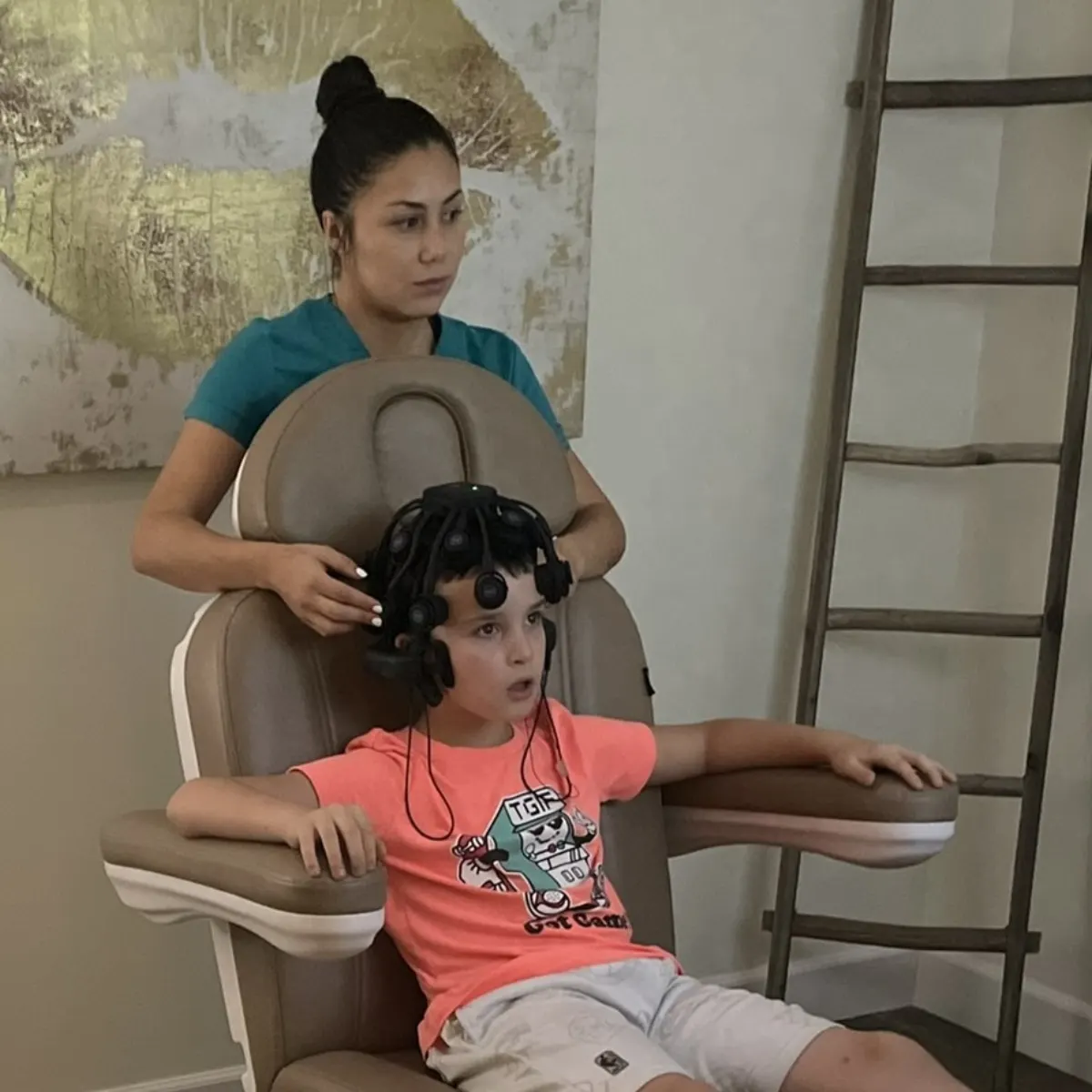
Sessions are designed to be engaging. Children interact with animations, specialized video games, or music that respond in real time to their brainwaves. The training feels more like play than clinical treatment. No substances are used, no electricity enters the brain, and a trained technician supervises every session.
Many parents report improvements in homework completion, mood control, and classroom focus. For Arizona families, eligible students may fund sessions through the Empowerment Scholarship Account (ESA) program. Individual results vary.
Can neurofeedback help adults with ADHD focus at work?
Adult ADHD is often underdiagnosed. It brings a clear set of challenges: trouble prioritizing tasks, chronic procrastination, unfinished projects, and missed deadlines. Impulsive choices can also affect career and relationships. Many adults go decades without a diagnosis — assuming it was a character flaw, not a brain pattern.
qEEG brain mapping at Neuron Connect makes those patterns visible. Neurofeedback training then helps the brain build more stable, efficient executive function over time. Adults often notice gains in task initiation, working memory, and mood control. They also find it easier to hold focus through complex work with less redirection.
If you want to reduce medication use, explore a drug-free option, or improve performance under pressure, neurofeedback may be worth a conversation with our team. Results are individual and not guaranteed.
Neurofeedback: a workout for the neural pathways of attention.
Through repeated sessions (typically 30 to 40), the brain creates more stable, efficient neural connections. Many patients begin noticing improvements in focus and impulse control within the first 10 to 15 sessions.
Evidence-Based
Supported by over 50 years of clinical research and FDA-cleared technology.
Lasting Change
Benefits are designed to persist after treatment ends, unlike ongoing medication management.
Multi-Age Support
Highly effective for children, students, and professional adults at any stage.
Clinical Outcomes
Averages based on internal clinical outcomes and longitudinal ADHD neurofeedback studies.
Learn more about the science behind neurofeedback for ADHD, including how many sessions to expect and what results look like over time.
Read: Can Neurofeedback Help Manage ADHD Without Medication?Before starting neurofeedback, a qEEG brain map identifies your specific brainwave patterns — so the protocol is personalized to you, not generic.
What is qEEG Brain Mapping?ESA scholarship and HSA funds accepted.
Neurofeedback is an approved Empowerment Scholarship Account (ESA) and HSA-eligible therapy, helping Arizona families access care with pre-tax or scholarship funds.
- ESA scholarship eligible
- HSA and FSA accepted
- Multiple Arizona locations
- Attorney-lien friendly
Common questions about neurofeedback for ADHD
Is neurofeedback for ADHD backed by research?
A growing body of peer-reviewed research supports neurofeedback for ADHD. A 2009 meta-analysis by Arns and colleagues, in Clinical EEG and Neuroscience, found large effect sizes for inattention and impulsivity. The authors rated neurofeedback as "Efficacious and Specific" — the highest evidence threshold at the time. A 2019 review by Van Doren, Arns, and colleagues, in European Child and Adolescent Psychiatry, found those gains held at 2 to 12 months after training ended. Research is ongoing and outcomes vary. The evidence makes neurofeedback a meaningful non-drug option to discuss with your clinician.
Can neurofeedback reduce reliance on ADHD medication?
As attention and impulse control improve, some people and their doctors re-evaluate medication needs. Neuron Connect does not prescribe, adjust, or advise stopping any medication. All medication changes must go through your prescribing doctor or psychiatrist. Neurofeedback may complement existing medication or serve as a primary drug-free option. That choice is yours and your doctor's to make together. Our role is brain training support. Your prescribing physician handles all medication decisions.
How many neurofeedback sessions does ADHD treatment typically require?
Most ADHD protocols at Neuron Connect involve 30 to 40 sessions, two to three times per week. Many clients notice changes in focus, sleep, or mood control within the first 10 to 15 sessions. The exact number depends on your qEEG brain map results, your age, and how your brain responds. Benefits from a completed course are designed to persist after training ends. Unlike daily medication, you train to improve — not to keep up ongoing sessions. Your initial assessment will include a personalized timeline.
Does neurofeedback work for children with ADHD?
Yes, neurofeedback has been used with children as young as five. Sessions are engaging by design. Children interact with animations, video games, or music that respond to their brainwaves in real time. This makes training feel more like play than clinical treatment. It also keeps the sessions enjoyable for younger patients. For families worried about stimulant side effects or looking for a drug-free option, neurofeedback may be a well-tolerated alternative or add-on. Safety is a top priority. No substances are used, no electricity enters the brain, and trained technicians supervise every session.
Is neurofeedback covered by Arizona's ESA scholarship?
Yes. Neurofeedback is an approved service under Arizona's Empowerment Scholarship Account (ESA) program. Eligible students with disabilities — including ADHD — can use ESA funds to pay for sessions at Neuron Connect. HSA and FSA accounts may also apply, depending on your plan. Our care coordinators can walk you through the payment and reimbursement process. For eligibility details, visit azed.gov/esa. If you already have ESA benefits, our team can provide documentation for your reimbursement request.
How is neurofeedback different from ADHD medication?
Stimulant medications for ADHD work by temporarily altering neurotransmitter levels. They require daily use to maintain their effect. When the medication wears off, symptoms return. Neurofeedback takes a different approach. It trains the brain to self-regulate through operant conditioning. Real-time feedback reinforces more focused, organized brainwave patterns over a course of sessions. Rather than using a substance, the process works with the brain's own plasticity. Gains from a completed course are designed to last. Neurofeedback carries no systemic side effects, though individual responses vary and no specific outcome can be guaranteed.
The information on this page is for educational purposes and is not a substitute for professional medical advice, diagnosis, or treatment. Always consult a qualified healthcare provider about your specific situation.
Stop struggling against your brain. Start training it.
Schedule a qEEG Brain Map to see the data behind your attention patterns, then receive a personalized neurofeedback protocol designed to support lasting focus and clarity.
Attorney-lien friendly. Se Habla Español. Multiple Arizona locations.